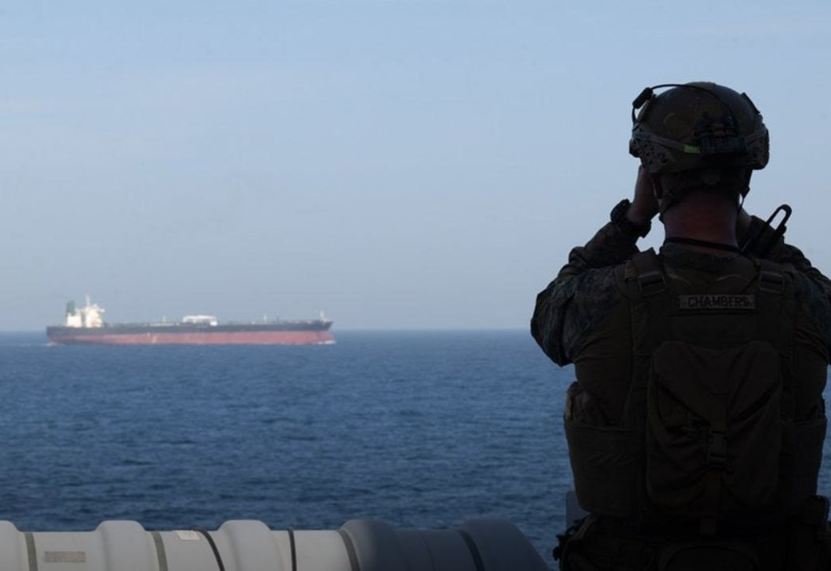
President Donald Trump announced the United States is reinstating a naval blockade of Iranian ports and will impose a 20 per cent charge on all cargo passing through the Strait of Hormuz, declaring the US the 'Guardian' of the waterway as both nations exchanged heavy drone and missile attacks.
Trump said on Monday that the blockade would take effect at 20:00 GMT on Tuesday, 14 July. The US Navy-led Joint Maritime Information Center said in an advisory that the blockade would cover all of Iran's ports, oil terminals and coastal areas, and that any vessel suspected of entering or departing without authorisation would be subject to interception, diversion and capture.
In a post on his Truth Social platform, Trump wrote that the US would be "reimbursed, at the rate of 20% on all cargo shipped" for providing safety and security through the strait. He said the waterway "will remain OPEN, with or without Iran" and that "all other countries will have fair and open use of the Strait."
The announcement came after the US and Iran exchanged strikes overnight. The US military said it had struck Iranian air defence systems, coastal radar sites, missile and drone capabilities and small boats. Iran's Islamic Revolutionary Guard Corps said it responded by targeting US military facilities in Bahrain and Kuwait, destroyed radar systems in Oman, and hit fuel tanks and ammunition depots at Prince Hassan airbase in Jordan.
Iran's Foreign Minister Abbas Araghchi responded sarcastically to Trump's toll proposal, writing on social media that "POTUS is absolutely right" that whoever provides safe passage "should be compensated for this service." Araghchi said Iran would "remain so FOREVER" the strait's guardian and that "20% is of course too much. We will be fair."
Iran's top military headquarters said it would not allow the US to "interfere in the management" of the Strait of Hormuz, warning that any cooperation with the US would be considered an act of war against Iran's sovereignty.
The International Maritime Organization, the UN agency regulating global shipping, said it "stands firmly against charging fees for passage through straits used for international navigation," according to Reuters. A spokesperson said there is "no legal basis through which to introduce mandatory tolls simply to transit through a strait."
In Layman's Terms
The Strait of Hormuz is a narrow waterway between Iran and Oman through which roughly one-third of the world's seaborne oil passes. It is one of the most important shipping routes on Earth.
Trump is saying the US will now stop Iranian ships and ships carrying goods to Iran from using this route. At the same time, he is demanding that all other countries pay a 20 per cent fee on cargo they ship through the strait in exchange for US military protection.
Iran is rejecting this. Its leadership says Iran has always controlled and protected the strait, and that it will continue to do so. Iran's foreign minister mocked Trump's proposal by saying Iran would charge a lower rate if it were to collect tolls.
The International Maritime Organization, which sets rules for global shipping, says international law does not allow any country to charge fees for passage through international waterways. This puts Trump's 20 per cent toll at odds with established international shipping law.
Why This Matters
The Strait of Hormuz is critical to global energy supplies. Disruptions to shipping through it can drive up oil prices worldwide and affect economies far beyond the Middle East. A blockade or toll system could make shipping more expensive and risky, raising costs for consumers and businesses globally.
The escalating military exchanges between the US and Iran raise the risk of a wider conflict in the region. Both sides have demonstrated they are willing to strike each other's military targets, and the rhetoric from Iranian military officials suggests they view further US action as a potential trigger for a broader regional war.
For shipping companies and countries that rely on oil from the Gulf, the uncertainty is immediate. Traffic through the strait has already plummeted, according to ship tracking data cited by the sources.
What We Still Don't Know
It remains unclear how effectively the US Navy could enforce such a blockade in practical terms, given the strait's width and the volume of traffic that normally passes through it.
The sources do not explain what prompted Trump to renew the blockade and toll demand at this particular moment, or whether there are ongoing negotiations between the US and Iran.
It is also unclear whether other countries will accept the 20 per cent toll or challenge it, and how the US would respond if major shipping nations refuse to pay.
The sources do not detail the current state of any ceasefire or interim deal that was previously negotiated between the US and Iran.
Sources: The Guardian World, BBC World, NYT, The Guardian World





Comments
No account needed — just choose a display name. Comments are moderated; if one is removed, the reason is shown.
No comments yet — be the first to share your thoughts.